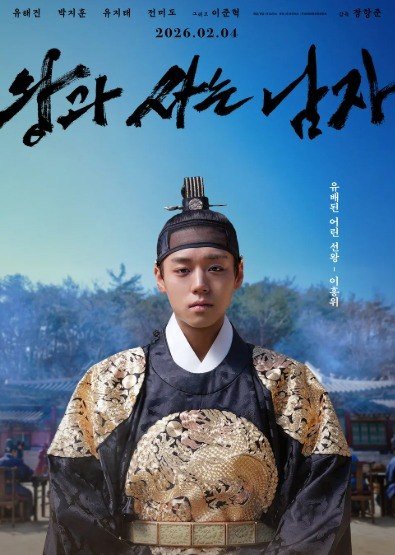
Over this year’s Lunar New Year holiday, Korean theaters were talking about one film. The Man Who Lived With the King (왕과 사는 남자) crossed ten million admissions and became the 34th film in Korean cinema history to hit that mark. What surprised me, watching it, is that this isn’t a flashy action film or a twist-heavy political thriller. It’s almost the opposite. It’s a quiet story about a deposed boy king and the village headman assigned to guard him, and the handful of months they spent together in a remote mountain village in Gangwon-do. I kept wondering why a film this understated moved so many people so deeply. That question stayed with me long after the credits rolled, so I wanted to write it down here.
The Basics
The Man Who Lived With the King opened on February 4, 2026, timed for the Lunar New Year holiday. It’s directed by Jang Hang-jun (장항준), and stars Yoo Hae-jin (유해진), Park Ji-hoon (박지훈), and Yoo Ji-tae (유지태). It’s technically a period drama (사극), but it plays more like a quiet human drama than a court intrigue. The story is set in 1457, in Cheongnyeongpo (청령포), Yeongwol (영월), Gangwon Province.
The People Who Bring It to Life
Yoo Hae-jin as Eom Heung-do
Yoo Hae-jin plays Eom Heung-do (엄흥도), the headman of a mountain village in Yeongwol. He’s simply been assigned to watch over an exiled prisoner — except that prisoner used to be the king of the country. Yoo Hae-jin brings his usual understated, slightly wry warmth to a man who is visibly thrown off balance by that fact. What starts as a man doing his assigned duty slowly becomes something else, as he stops seeing the boy in front of him as “the king” and starts seeing him as simply a person.
Park Ji-hoon as Yi Hong-wi (Danjong)
Park Ji-hoon plays Yi Hong-wi (이홍위), the young deposed king sent into exile — the birth name of the historical King Danjong. He arrives in the village having lost everything overnight, refusing to eat. The moment he finally accepts a simple, humble meal the villagers put together for him is where his walls start to come down, and Park Ji-hoon plays that shift with a restraint that says more than words could.
Yoo Ji-tae as Han Myeong-hoe
Yoo Ji-tae plays Han Myeong-hoe (한명회), a real historical figure and the key strategist behind the faction that pushed the boy king’s own uncle onto the throne. He isn’t written as a cartoonish villain — he’s the cold logic of a power struggle given a face, and his presence adds real tension to the film.
Some Korean History You’ll Want Before Watching This
To really get this film, it helps to know a bit of history first — because this isn’t fiction. It’s based on an actual tragedy from the early Joseon dynasty.
The Joseon dynasty and the grandson of King Sejong. Joseon (1392–1897) was Korea’s longest-lasting dynasty, ruling for over five centuries. Its fourth king, Sejong the Great, is the most beloved king in Korean history — he’s the one credited with creating Hangeul, the Korean alphabet. The young king at the center of this film, Yi Hong-wi, known as King Danjong, was Sejong’s own grandson.
A boy king at eleven. In 1452, Danjong’s father, King Munjong, died just two years into his own reign, and eleven-year-old Danjong was suddenly placed on the throne. He was far too young to rule on his own, so power was split among court officials and royal relatives — an unstable arrangement that planted the seeds of everything that followed.
Gyeyu jeongnan — the uncle’s coup. In 1453, Danjong’s uncle, Grand Prince Suyang (later King Sejo), staged a coup known as Gyeyu jeongnan, purging the court’s leading officials and seizing power for himself. At first he kept up the appearance of simply assisting his young nephew, but by 1455 he forced Danjong to hand over the throne entirely. Danjong was stripped of his royal title and demoted to Nosangun (노산군) — no longer king in any sense.
Exile to Cheongnyeongpo. In 1457, when a plot by loyalist officials to restore Danjong to the throne was uncovered, things got worse. Sejo had Danjong exiled to Cheongnyeongpo in Yeongwol, Gangwon Province — a spot surrounded by river on three sides and a sheer cliff on the fourth, essentially a natural prison you can’t leave without a boat. That’s where a sixteen-year-old former king found himself, utterly alone. This is exactly the period the film imagines: the relationship that might have existed between Danjong and the village headman assigned to watch him, Eom Heung-do.
Eom Heung-do’s loyalty, at the risk of his own life. What makes this even more striking is that Eom Heung-do was a real person. According to historical records, after Danjong’s death, the court reportedly forbade anyone from even claiming his body — burying a former king who’d died branded a traitor was itself treasonous. And yet Eom Heung-do, a low-ranking local clerk in Yeongwol, is said to have secretly recovered Danjong’s body and buried it in the mountains, knowing full well what it could cost him. Centuries later, once Danjong’s name and reputation were formally restored, Eom Heung-do’s loyalty was also officially recognized, and his descendants were honored by the state. That’s where the film’s title comes from — he wasn’t just a man who guarded a king or served a king. He was a man who stayed by his side, all the way to the end, at the risk of his own life.
Once you know all of this, every quiet scene of the two of them sharing a simple meal or a passing conversation stops feeling like sentimental filler and starts feeling like a human bond that cuts straight through rank and the threat of death. In Korea, the story of Danjong and Eom Heung-do has long stood as one of the defining examples of loyalty (충절) and personal devotion — and I think that’s exactly why this film reached so far beyond the usual audience for a period drama.
What the Story and Direction Left Me With
What I appreciated most is that the film handles genuinely tragic material without ever tipping into melodrama. The court’s power struggles only reach us secondhand, like rumor drifting in from outside — the camera stays fixed on the mountains of Yeongwol, on the two of them sharing meals, watching the seasons quietly turn. There isn’t a single battle scene, and yet the tension never lets up, probably because everyone in the audience already knows how this story ends. That foreknowledge is exactly what makes the ordinary, unremarkable days the two men share feel so much more tender.
On the Ending (⚠️ Spoilers Ahead)
If you’d rather go in knowing nothing, skip this paragraph.
As history already tells us, Danjong dies in exile. The film lingers less on the tragedy of that moment itself, and more on the choice Eom Heung-do makes as he watches it happen. Faced with an order forbidding anyone from even claiming the body, the moment he decides to stay — not just as a guard, but as the one person who sees this through to the very end — is the film’s real climax. Instead of a dramatic twist, what stays with you is the quiet resolve of one man risking everything he has.
Places You Can Actually Visit — Cheongnyeongpo and Jangneung
The setting of this film is a real place you can visit. Cheongnyeongpo (청령포) in Yeongwol, Gangwon Province, still keeps the same geography today — you still need to cross by ferry to reach it, which gives you at least a small sense of the isolation Danjong must have felt. Nearby is Jangneung (장릉), Danjong’s royal tomb, an unusual case among Joseon royal tombs for being built so close to the site of a king’s exile. If you’re looking for historical places to visit in Korea, this quiet, somewhat melancholy site might stay with you just as long as any of the grand palaces.
Closing Thoughts
In the end, The Man Who Lived With the King isn’t really a story about power or revenge. It’s a story about one person who stayed by another’s side even under the threat of death. If you’re expecting a lavish, sweeping period epic, this might feel quieter than you’d expect. But if you’re looking for a quiet story that leaves a lasting feeling behind, I’d recommend this one. And if you have any interest in Korean history, this film might help you understand a little better why the story of Danjong and Eom Heung-do still lives on in the Korean imagination, centuries later.