Netflix’s Tantara brings Song Hye-kyo and Gong Yoo into a period drama about the ambitions and harsh realities of Korean show business from the 1960s through the 1980s. Reading that era through today’s K-pop agencies, social media, and global fandom would be misleading. This guide explains the older system in which radio, live stages, terrestrial television, personal introductions, and state review could determine who became visible and who disappeared from the schedule.
What Is Netflix’s Tantara About?
Netflix describes Tantara as a drama about people who kept Korea’s show world alive during years of crackdowns and fear, fighting for a stage where perseverance might become glory. Its official title page lists Song Hye-kyo, Gong Yoo, Kim Seol-hyun, Cha Seung-won, and Lee Hanee among the cast. The creators listed by Netflix are writer Noh Hee-gyung and director Lee Yoon-jung.
About Netflix’s 2026 Korean slate gives the historical range: the series depicts the ruthless realities of Korea’s entertainment industry across the 1960s and 1980s. That broad span covers enormous changes in media, politics, technology, and public taste. A performer beginning with live stages and radio in the 1960s would encounter a much more television-centered industry by the 1980s.
The official material does not establish that the lead characters are direct portraits of particular real entertainers. It also did not provide an exact release date or episode count in the sources checked as of August 1, 2026. Until Netflix publishes those details, Tantara should be introduced as a historical drama about a real industry context, not automatically as a true story.
That distinction does not make the history less important. Fiction can show how a system felt to people who depended on it even when its central characters are invented or composite figures.
Before K-pop: Korea’s Patchwork Show-Business World
The Korean entertainment business of the 1960s was not a smaller version of today’s idol industry. Large contemporary agencies can combine trainee development, music production, visual branding, fan platforms, touring, advertising, and global distribution. Earlier performers moved through a looser and less secure network of theater shows, musical troupes, radio, film studios, night venues, local events, record companies, and later television stations.
A singer might build practical skill in front of a live audience before gaining a radio opportunity. An actor might cross between film and broadcasting because no single channel guaranteed a stable career. Bandleaders, composers, producers, venue owners, announcers, and personal contacts could all become gatekeepers. The boundary between glamorous celebrity and precarious gig worker was thin.
The Korean word ttantara has long carried a belittling association with entertainers or traveling performers. It is often connected in popular explanations to the imitation of instrumental sounds, but a single definitive etymology should not be claimed without stronger linguistic evidence. Its social force is clearer than its precise origin: it can reduce skilled performers to noisy people who amuse others.
Using the word as a title may reclaim a label that once denied artistic labor its dignity. That is an interpretation of the title and official premise, not a confirmed statement of the drama’s final message.
The 1960s: Radio, Live Stages, and the Arrival of Television
In the early 1960s, television was not yet the ordinary household medium it would become. Radio and live performance remained essential ways for music and personalities to reach the public. Theater revues, public stages, military-related entertainment circuits, and urban nightlife all contributed to a performer’s working world.
Television then introduced a new kind of visibility. Korean history materials identify the opening of KBS-TV in 1961 and TBC-TV in 1964, followed by the growth of additional broadcasting in the period. Dates can be presented differently depending on whether a source counts a corporation, station, or regular transmission, so a drama guide should avoid building a rigid timeline from one unexplained date.
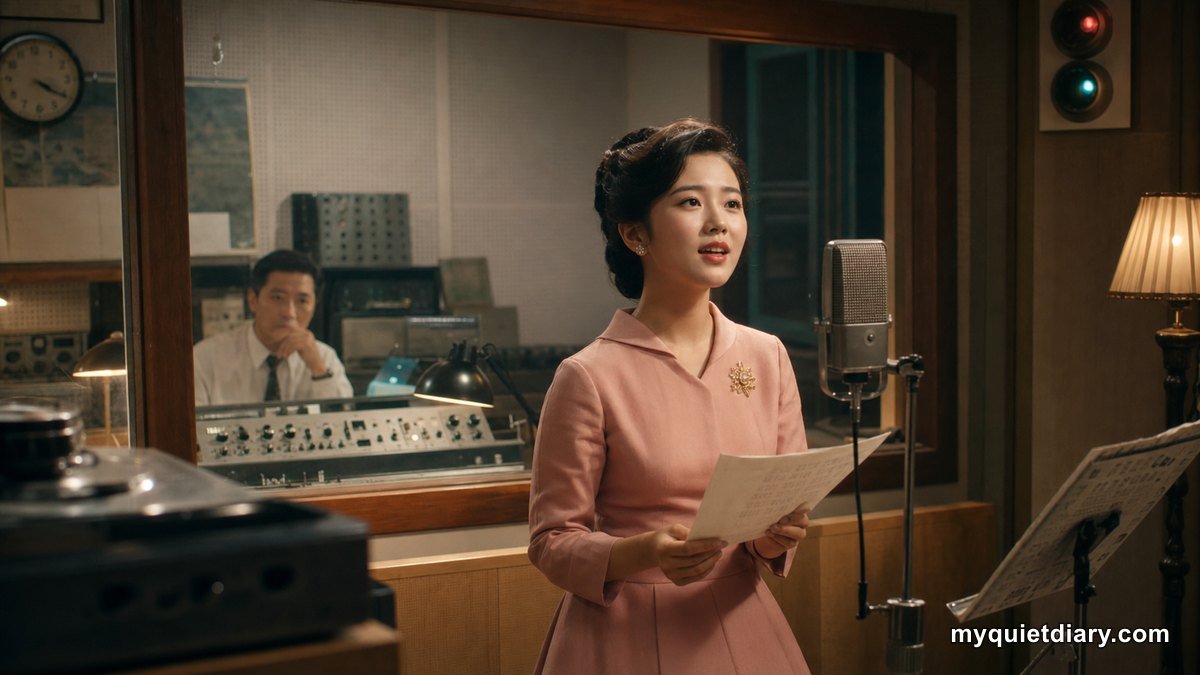
Image source: Wikimedia Commons / Shidong, Public Domain. Cropped, color-adjusted, and processed with a myquietdiary.com watermark.

What matters for viewers is the structural change. Radio could make a voice familiar; television made appearance, gesture, clothing, and camera behavior part of a public identity. A performer who had learned to project to the back of a theater now had to understand close-ups and broadcast timing. A singer’s visual presence could become as important as vocal recognition.
Screen access was scarce. There were few channels, production resources were limited, and broadcasting schedules could not accommodate everyone seeking attention. Appearing on television could sharply increase name recognition, while exclusion could leave a talented performer dependent on regional or nighttime stages.
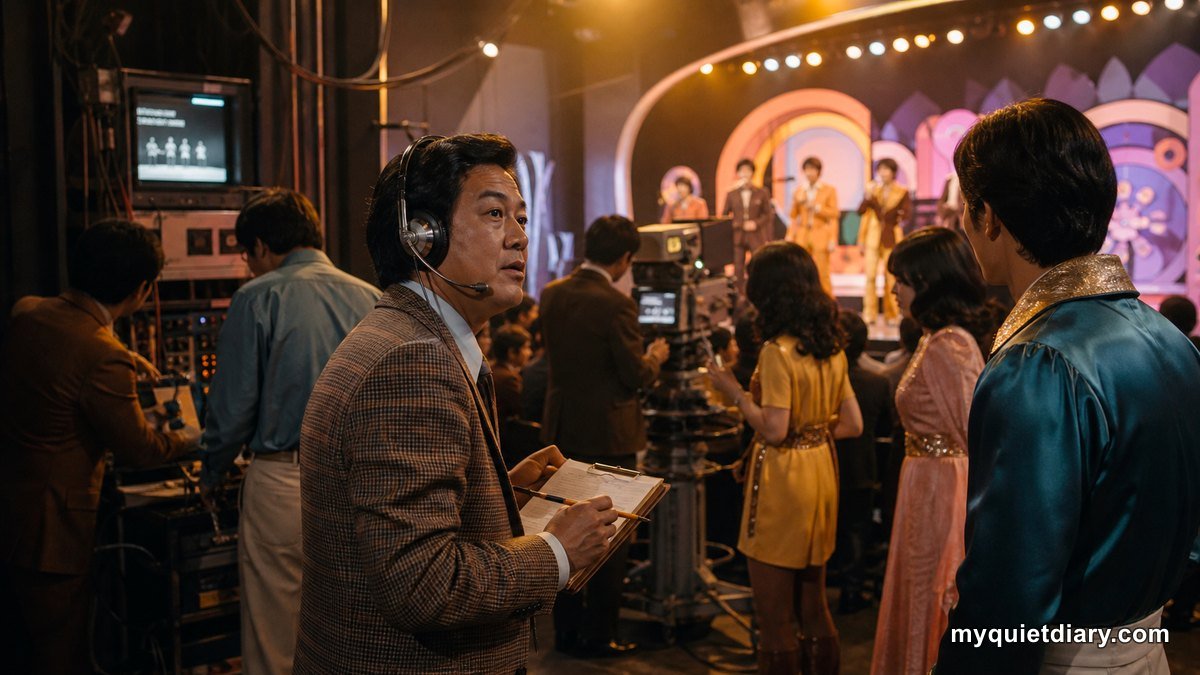
Image source: Wikimedia Commons / unknown author, Public Domain (PD-South Korea and PD-1996). Cropped, color-adjusted, and processed with a myquietdiary.com watermark.

This scarcity shaped relationships. Introductions, auditions, patronage, and reputations mattered because there was no open video platform for bypassing established broadcasters. Talent had to be recognized by people controlling a limited number of microphones, stages, and cameras.
The 1970s: Network Competition Under Tight Control
During the 1970s, television became increasingly central to leisure and popular culture. Competition among broadcasters could create more programs and stars, but the growth of media did not produce unrestricted expression. South Korea was under authoritarian rule, and broadcasting and popular arts operated within powerful systems of review and political control.
National Archives of Korea materials document that, from the 1960s onward, broadcasting ethics bodies reviewed music programs and designated songs as prohibited from broadcast. The reasons and institutions changed over time. Music could encounter restrictions connected to lyrics, moral standards, style, political sensitivity, or the authorities’ view of appropriate public culture.
A banned song was not merely one unavailable product in a large digital catalog. When terrestrial broadcasting was the main route to a national audience, removal from radio or television could cut off the mechanism that created popularity. A record might physically exist while being absent from the spaces where most people discovered music.
Control also encouraged self-censorship. Writers, composers, producers, and performers did not always need to receive a formal prohibition before changing their work. If they anticipated review, they could alter a lyric, avoid a subject, adjust an outfit, or cultivate a publicly acceptable persona. The pressure entered the creative process before the audience heard the result.
That makes censorship dramatically richer than a scene in which an official simply stamps “banned” on a page. It can shape friendship, compromise, rivalry, and silence. One artist may accept changes to remain on television; another may refuse and lose access; a third may learn to communicate indirectly. The exact incidents in Tantara remain unknown before release, but the historical structure gives those choices credible stakes.
The 1980s: Television Power, Color Screens, and Bigger Stars
By the 1980s, terrestrial television held extraordinary cultural influence. Color broadcasting gave costumes, sets, makeup, choreography, and visual branding greater impact. Large entertainment and music programs could turn repeated exposure into nationwide recognition.
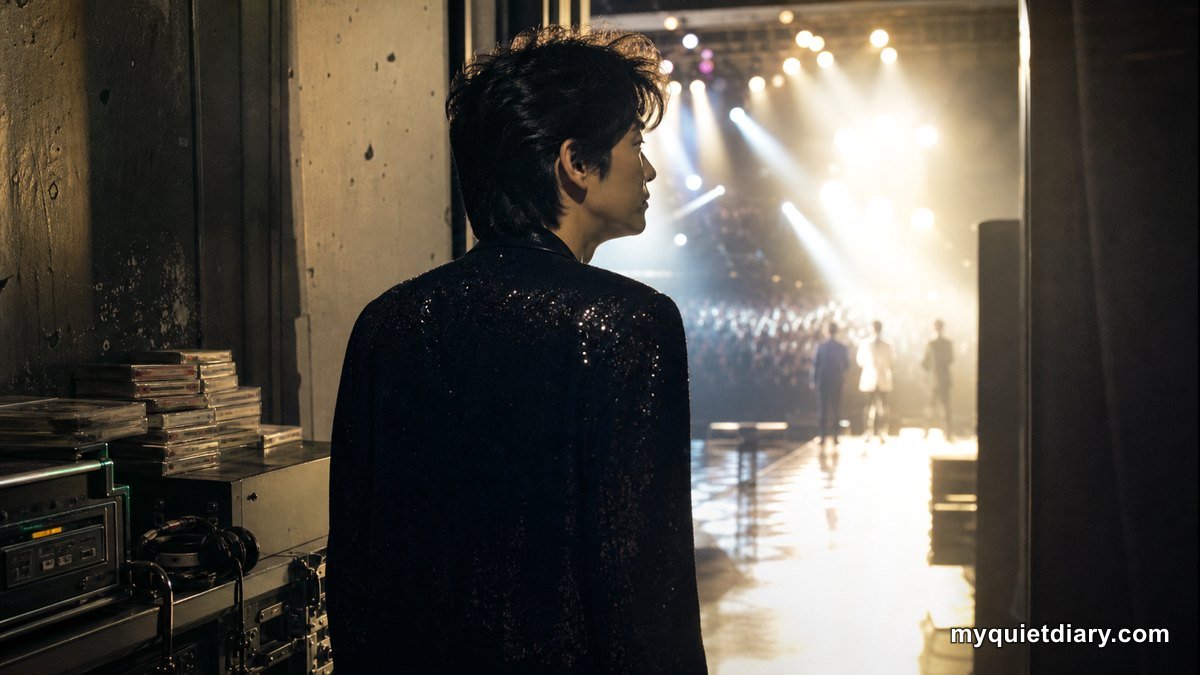
Image source: Wikimedia Commons / Visviva, Public Domain. Cropped, color-adjusted, and processed with a myquietdiary.com watermark.

This helped produce stars whose images were shared across regions rather than limited to a local performance circuit. Television could make a face feel familiar inside millions of homes. It also created a stronger expectation that entertainers manage their public image continuously. The performance no longer ended when the theater curtain came down.
Yet a brighter screen did not necessarily mean greater freedom. When only a few broadcasters could offer mass exposure, programming decisions carried immense power. A star who received repeated appearances could become ubiquitous; a performer removed from schedules could lose the most efficient route to the public.
The best historical drama will make viewers feel that difference. Characters should not speak as if they know streaming, viral clips, or global fan translation are waiting in the future. Their ambitions must be shaped by the routes available to them: getting a song approved, finding a stage, entering a studio, staying on a schedule, and surviving the people who can close those doors.
How Censorship Shaped Songs, Films, and Careers
The National Archives’ history of prohibited popular songs provides a concrete measure of change. In 1987, the Ministry of Culture and Information announced guidance for lifting bans, and a review began among 382 domestically prohibited songs, with works by writers who had gone to North Korea treated separately. The archival account states that 186 songs were released from prohibition.
The numbers reveal that censorship was not an occasional rumor around a few controversial artists. It produced a catalog of absent or restricted culture large enough to require systematic review. They also show that rules were historically contingent. A song treated as unacceptable in one political climate could later return to public circulation.
Film faced its own review institutions and production constraints. Korean Film Archive scholarship documents how censorship affected what could be made, shown, altered, or removed. A story covering multiple entertainment fields may therefore show similar pressures taking different forms: a song denied broadcast, a script changed, a scene cut, or a performer judged unsuitable.
Career consequences extended beyond individual works. Public visibility generates future work. Losing one broadcast could mean losing recognition, invitations, endorsements, or the confidence of investors. A ban or unofficial exclusion could also affect colleagues who depended on the same show or production.
This is why the word “industry” matters. Art was produced through institutions, not only through individual inspiration. A singer needed a song, musicians, rehearsal space, recording, approval, distribution, and access to the audience. A television actor needed a broadcaster willing and permitted to place the performance on air. Control at any point could reshape the final culture.
What the Word “Tantara” Suggests About Social Status
The title directs attention to the people whose work was consumed more readily than it was respected. Ttantara is not the neutral contemporary word yeonyein, meaning entertainer or celebrity. It carries the echo of dismissal: performers as unserious wanderers, attention seekers, or people making noise.
That dismissal hides labor. Live entertainers travel, rehearse, repeat material, read unpredictable audiences, protect their voices and bodies, negotiate pay, and depend on teams. Broadcast performers add camera discipline and the risk that one recorded image will define them. Fame can make this labor look effortless precisely because polished entertainment conceals preparation.
A period drama can reclaim the insult by centering the people who accepted unstable status to keep performing. It can also show why success did not erase vulnerability. The same public that adored a star could adopt the moral judgments promoted by institutions or tabloids. The same broadcaster that created a career could interrupt it.
Whether Tantara uses its title in exactly this way must be confirmed from the completed series and comments by its creators. Still, the historical connotation offers a useful lens: look not only at who becomes famous, but at who is considered worthy of dignity while doing entertainment work.
What Is Confirmed—and What the Drama May Fictionalize
The official facts are straightforward. Tantara is a Netflix Korean series listed for 2026. Netflix confirms its principal cast, Noh Hee-gyung as writer, Lee Yoon-jung as director, and the broad 1960s-to-1980s entertainment-industry setting. Those facts can be stated without speculation.
An exact release date, episode count, and direct real-life models for the characters were not established in the official sources reviewed for this article as of August 1. The series may later clarify them. Until then, claims that a character “is” a particular singer or actor should be treated cautiously.
Historical drama inevitably compresses. A fictional singer can combine conditions experienced by several generations. Institutional changes that took years may appear through one conflict. A television station, venue, or production team may be redesigned for narrative clarity. Such changes are not automatically errors.
Viewers can ask two separate questions. Did this exact scene occur? And does the scene accurately express the choices and limits produced by the period’s institutions? The first is a fact-checking question. The second is a question of historical interpretation. A strong drama may use fictional people to answer the second honestly without pretending to document the first.
The element I find most promising in the premise is not retro styling by famous actors. It is the possibility of showing who controlled access to a stage and what performers had to hide, trade, or endure to remain there. That is an expectation based on the official concept, not a firsthand review of unreleased episodes.
Understanding this history also changes how contemporary Korean entertainment looks. Today’s global K-content did not emerge from a timeless, unified system. It grew after decades in which performers navigated scarce broadcast access, social prejudice, technological change, and political review. Tantara has the opportunity to make that difficult continuity visible—provided it remembers that the lights onstage were never the whole industry.
Sources
- Netflix — Tantara — verified August 1, 2026
- About Netflix — 2026 Korea slate — verified August 1, 2026
- National Archives of Korea — Popular Music and Prohibition — verified August 1, 2026
- Encyclopedia of Korean Culture — Popular Music — verified August 1, 2026
- National Institute of Korean History — Growth of Korean Broadcasting — verified August 1, 2026