The Remarried Empress is one of the clearest examples of a Korean story traveling from serialized prose to comics and then to global streaming television. Instead of retelling its entire plot, this guide explains why Navier’s divorce-and-remarriage premise is so effective and what must change when a story built for reading becomes live action. As of August 1, 2026, Disney+ has placed the series in its 2026 Korean lineup, but an exact regional release date and episode count have not been officially confirmed.
What Is The Remarried Empress About?
The official premise is remarkably direct. Navier is the empress of the Eastern Empire. When her husband, Emperor Sovieshu, returns with another woman and asks for a divorce, Navier agrees—but requests permission to marry Heinrey, a prince from a rival kingdom.
That setup has the clean force of a fairy tale reversal. Navier is publicly rejected, yet the title does not define her as an abandoned wife. It defines her by what she does next. She turns a private humiliation into a political negotiation and refuses to let the emperor control the ending of her story.
The central attraction is therefore bigger than a romantic triangle. Marriage in this fictional court is both an emotional relationship and a tool of state power. Divorce can affect legitimacy, diplomacy, succession, and public reputation. Navier’s decision makes readers follow a love story and a political strategy at the same time.
That combination also explains the premise’s international appeal. An unfair relationship and the desire to recover personal agency need little cultural translation. The imperial titles and court rules provide unfamiliar fantasy texture, while the emotional question remains simple: what can a highly capable person do when the institution she served decides she is replaceable?
It Started as a Korean Web Novel, Not a TV Script
The Remarried Empress was not originally designed around cameras, actors, or hour-long episodes. It began within Korea’s web-novel ecosystem before becoming a webtoon and, eventually, a live-action Disney+ project.
A Korean web novel is serialized digital fiction, commonly read in short installments on a phone. That format influences how a story moves. Chapters need a reason for the reader to tap “next,” return the following day, or purchase another installment. Emotional turns, revelations, confrontations, and cliffhangers can arrive in a long sequence rather than being concentrated into a small number of television episodes.
The form is also unusually good at interiority. Prose can remain inside Navier’s calculations while she maintains a controlled public face. It can explain court rules, recall a past slight, or contrast what a character says with what that character intends. None of those tools transfer automatically to television.
The webtoon adds a second transformation. Clothing, palace rooms, facial expressions, and differences in status become visible rather than described. A reader can understand the emotional temperature of a scene from color and composition before reading a speech bubble. The comic establishes a visual identity that many fans may treat as definitive, even though the original source began in prose.
Live action adds performance, movement, music, production design, and editing. It can make a silent exchange feel immediate in a way a paragraph cannot. At the same time, it has less room for explanatory thought and must fit a production schedule and episode structure. Calling the drama “a webtoon adaptation” is convenient, but it hides the more interesting chain: web novel, webtoon, translation, global readership, and television.
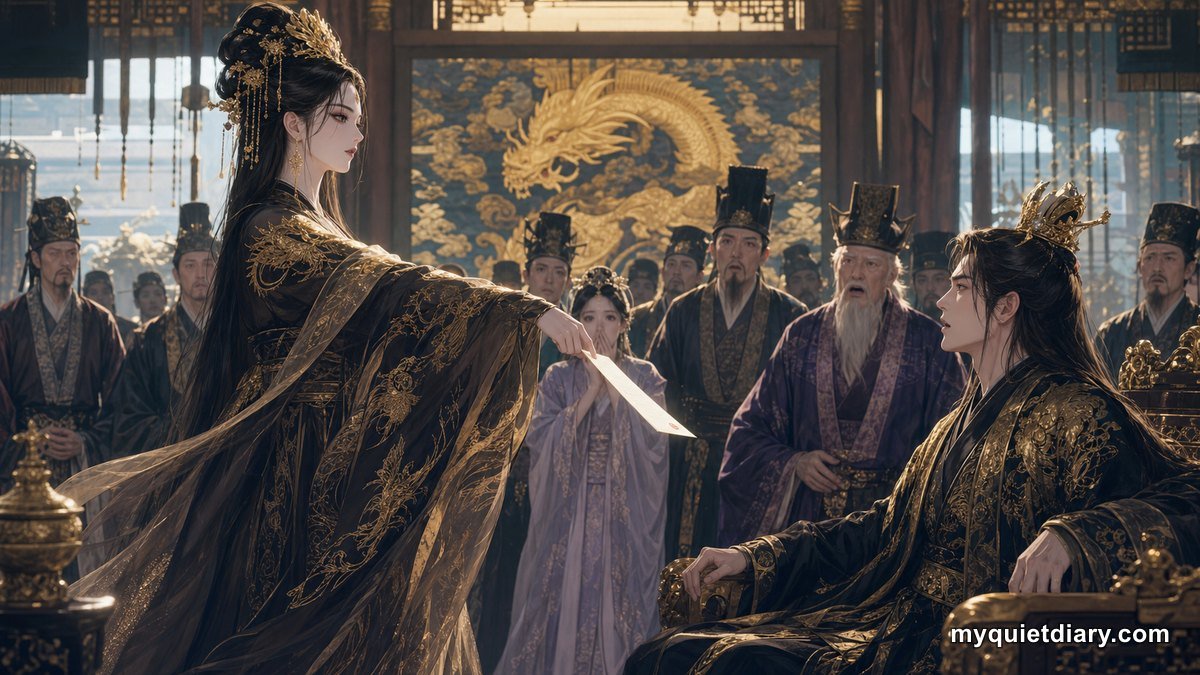
Image source: Wikimedia Commons / Maskkwon, CC BY-SA 4.0. Cropped, color-adjusted, and processed with a myquietdiary.com watermark.

How the Story Became a Global WEBTOON Hit
Disney+ Japan’s official announcement described the web novel and webtoon franchise as having more than 2.6 billion cumulative views worldwide at the time of its 2025 release. The same announcement noted that it placed second in LINE Manga’s 2023 annual ranking in Japan. Those are platform-era popularity indicators rather than a traditional count of books sold, so they should be read with their date and context attached.
Even with that qualification, the scale shows that the drama is not introducing an obscure property. It is adapting a story whose characters already have large, multilingual fan communities. Many viewers will arrive with fixed ideas about Navier’s temperament, Heinrey’s charm, Sovieshu’s decisions, and Rashta’s role in the conflict.
Why did the story travel? Its emotional architecture is highly portable. Public disrespect, an unequal marriage, class insecurity, and the wish to rebuild one’s life are legible across borders. The fictional empire creates distance from contemporary politics, allowing readers to enjoy exaggerated etiquette and royal spectacle without needing a detailed knowledge of Korean history.
At the same time, the route of that success is distinctly connected to Korean digital publishing. A serialized story can prove its audience before a costly screen production begins. A webtoon can then give the IP a shareable visual form. Official translations reduce the distance between Korean publication and international fandom. By the time a streamer announces a drama, the property already comes with years of reader discussion, fan art, rankings, and expectations.
That is a commercial advantage, but it creates creative pressure. A completely faithful adaptation is impossible because prose, vertical-scroll comics, and television organize time differently. Yet every visible change can become a point of debate among readers who have lived with the work for years.
The Confirmed Principal Cast
Disney+’s official 2026 lineup confirms Shin Min-a, Ju Ji-hoon, Lee Jong-suk, and Lee Se-young as the drama’s four central stars. They are associated with the story’s main court relationships. The official sources reviewed for this article do not establish every one-to-one mapping between those four actors and Navier, Sovieshu, Heinrey, and Rashta, so this guide does not infer the assignments. The materials establish the cast and broad premise, but they do not yet give viewers enough evidence to judge how the completed performances will interpret the source.
The key challenge is not simply whether an actor resembles a drawing. Navier needs to communicate thought without constantly explaining it. Her restraint should not be confused with passivity. Sovieshu must carry institutional power while making emotionally consequential choices. Heinrey needs to function as more than an ideal alternative husband, because his position also carries political interests. Rashta’s story raises questions of class and survival that can become shallow if she is presented only as an obstacle.
For that reason, the drama’s most important casting achievement would be a believable balance of power. Each conversation should reveal who can speak freely, who must perform obedience, and who understands more than they say. Those relationships matter more than matching every costume panel or recreating a fan-favorite image exactly.
It is also too early to review the chemistry, acting, or character development. Promotional materials can show visual direction, but they cannot establish how a performance develops across full episodes. Until the series is available, statements about its success in those areas would be expectation, not observation.
What Disney+ Must Translate From Page to Screen
Inner Monologue and Court Politics
The first major adaptation problem is Navier’s interior life. In prose, readers can understand every calculation beneath a formal answer. A television scene cannot simply reproduce paragraphs of thought. If dialogue explains everything, the court may feel unnatural. If explanation disappears entirely, viewers may miss why a small breach of etiquette is politically dangerous.
Screen language must do that work through performance and design. A pause before an answer can indicate calculation. Blocking can place one character at the center while isolating another at the edge of the room. Reactions from servants and officials can show that a private argument has public consequences. Editing can connect a seemingly polite statement to the person it threatens.
The court rules also need to be understandable without turning every episode into a lecture. The strongest approach would let viewers learn the system by watching characters use it. Who enters first, who sits, who is announced, and whose request becomes an order can explain hierarchy more elegantly than a long exposition scene.
Fantasy Scale Versus Emotional Clarity
The second challenge is spectacle. Palaces, ceremonies, uniforms, gowns, and diplomatic occasions are obvious attractions for a live-action fantasy romance. They signal that Disney+ is offering an imperial world rather than a contemporary office romance with crowns added.
But scale can work against the story if the sets become more memorable than the decisions made inside them. The central drama is not a contest over who receives the most luxurious costume. It is about who possesses legal, social, and emotional agency. Production design should make those power differences visible rather than covering them with decoration.
An enormous throne room, for example, matters when it shows how exposed Navier is during a public decision. A narrow private room matters when it removes ceremonial protection. Costume can show obligation as much as wealth: a crown may be beautiful while also representing the role a character cannot set aside.
Serialized Rhythm Versus Television Episodes
The third challenge is pacing. Web fiction can reward readers with many small confrontations and reversals. A television episode needs its own dramatic shape while also pushing the entire season forward. Repeating every exchange would slow the show; compressing too aggressively would make major changes in loyalty feel arbitrary.
The production will therefore have to combine events, shorten explanations, and perhaps reduce some supporting material. As of the verification date, Disney+ has not officially detailed which portions of the source will be covered or how many episodes will tell the story. Predictions about deleted characters, altered endings, or specific scenes should remain predictions—not facts.
This is where adaptation should be judged by function rather than inventory. A change can be successful if it preserves why a moment matters, even when its wording or location differs. Conversely, a scene recreated panel by panel can still fail if the surrounding emotional logic has been removed.
What Is Confirmed—and Still Unconfirmed—as of August 1, 2026
Several points are safe to state. The Remarried Empress is part of Disney+’s announced 2026 Korean series lineup. Disney+ describes it as a fantasy romance and has published the basic divorce-and-remarriage premise. Shin Min-a, Ju Ji-hoon, Lee Jong-suk, and Lee Se-young are officially attached. The property grew from a Korean web novel and webtoon with a very large international readership.
Other details require caution. An exact release date may vary by region and had not been confirmed in the official sources used for this article as of August 1. The final episode count and the exact boundary of the adaptation were also not officially established in those materials. The completed drama may clarify all of these points, but a future update should use Disney+’s title page or newsroom rather than fan posts as its source.
Claims about extraordinary production costs, detailed European filming routes, or guaranteed changes to the ending circulate in entertainment coverage and communities. They should not be used as proof of quality. A high budget can create scale, but it cannot by itself solve the narrative problems of interiority, pacing, and balanced characterization.
Readers approaching the series for the first time therefore need only the official premise. Reading the full web novel or webtoon may deepen comparison, but it is not a prerequisite for understanding the drama. Source readers, meanwhile, may enjoy treating the adaptation as a new interpretation rather than a moving copy of the comic.
Why This Adaptation Matters for Korean Story IP
The path of The Remarried Empress compresses a major feature of Korea’s contemporary story industry. A work can establish demand as writing, gain a visual identity as a webtoon, expand through translation, and then move into an expensive global screen format. Each step reaches a new audience while testing whether the same narrative core survives a new medium.
This model is not simply a factory line in which one successful object is copied four times. It is a series of redesigns. Prose gives access to thought. A vertical-scroll comic controls revelation through the movement of a reader’s thumb. Television controls duration, sound, performance, and simultaneous public attention. The IP remains recognizable, but its storytelling grammar changes.
That distinction is what makes this adaptation more interesting than another cast announcement. The most revealing question is not whether every scene looks identical to the webtoon. It is whether the live-action version can make Navier’s quiet reasoning visible and make court protocol feel like a source of real pressure.
I am especially interested in whether the drama keeps agency at the center of its spectacle. That is an editorial expectation based on the premise, not a review of unseen episodes. If the adaptation succeeds, viewers may remember the palaces and costumes, but they will understand that the decisive moment is a woman reclaiming authorship over what happens after a public rejection.
Sources
- Disney+ — Korean Dramas Coming in 2026 — verified August 1, 2026
- Disney+ Japan — The Remarried Empress announcement — verified August 1, 2026
- WEBTOON official site — verified August 1, 2026