The central question in Boyfriend on Demand is not whether a virtual boyfriend can be more perfect than a real one. The more revealing question is why a relationship requiring little time, negotiation, or emotional risk might appeal to an exhausted worker. This spoiler-free guide connects Netflix’s official premise with the wider context of working time in South Korea.
What Boyfriend on Demand Is About
Released on Netflix on March 6, 2026, Boyfriend on Demand follows Mi-rae, a webtoon producer worn down by her daily routine. Played by Jisoo, she enters a subscription-based virtual dating simulation that offers fantasy scenarios tailored to a user’s ideal type. Seo In-guk plays Kyeong-nam, her colleague and rival webtoon producer in the real world.
Kim Jung-sik directs the series, while Namgung Do-young and Kim Soo-yeon are credited as writers in Netflix’s production announcement. The main trailer presents virtual dates across multiple romantic genres, while Mi-rae and Kyeong-nam repeatedly encounter one another at work. Netflix even calls them “overtime work buddies,” making the connection between romantic fatigue and working life part of the official framing.
One distinction matters. Netflix describes the fictional service as a virtual dating simulation. Some commentary casually calls it an AI boyfriend platform, but the official material emphasizes virtual reality and designed scenarios. Unless a particular feature is confirmed on screen or by Netflix, it is more accurate to discuss simulated dating than to treat the story as a technical portrait of generative AI companions.
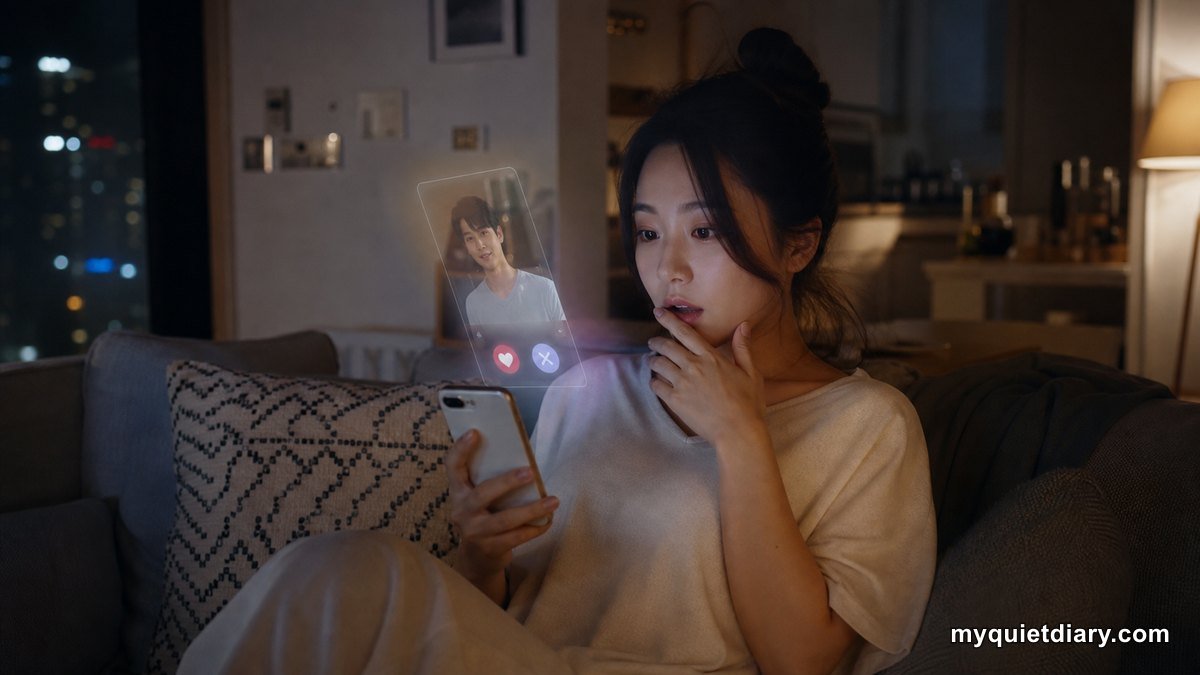
Why Mi-rae Has Energy for VR but Not Dating
Virtual dating is attractive not only because the partners are idealized, but because the cost of beginning is low. There is no need to coordinate calendars, cross the city, risk an awkward first meeting, or spend an evening wondering whether interest is mutual. The service opens with Mi-rae already positioned as the center of a story built for her satisfaction.
That difference matters for a tired worker. Real dating demands more than a free hour. It requires attention, curiosity, patience, and enough emotional reserve to accept uncertainty. A person may still want affection while having little capacity left for the practical and psychological work that precedes it.
Netflix’s description supports this reading without requiring us to invent scenes. Mi-rae is explicitly a webtoon producer worn out by the daily grind, and the real-world connection with Kyeong-nam develops alongside overtime. Virtual romance is therefore not simply the choice of someone who dislikes love. It can be read as an efficient refuge for someone whose usable time and emotional energy have already been claimed.
The service also removes the fear of wasting scarce leisure. A disappointing real date may consume an entire evening. A designed simulation promises a recognizable genre, an appealing partner, and an exit controlled by the user. That predictability is especially valuable when the rest of life feels governed by deadlines.
Overtime, Commuting, and Korea’s Time-Poor Workers
It would be inaccurate to explain every Korean workplace through overtime. South Korea contains many industries, contracts, schedules, and workplace cultures. Still, long hours and commuting provide a real social context for the drama’s premise.
The OECD’s 2024 economic survey of Korea describes a system with a 40-hour regular workweek and permitted overtime up to a total statutory ceiling of 52 hours. It also treats working time and commuting as continuing work-life balance challenges, even after reductions in average hours over the previous decade. The important point is not that every employee works the legal maximum. It is that the public conversation about usable time after work is grounded in recognizable conditions.
A commute intensifies the difference between clock time and free time. An employee may leave the office at a reasonable hour yet arrive home with little energy for another journey, another social performance, and another set of decisions. Dating competes not only with work but with sleep, exercise, household tasks, family obligations, and the simple desire to be alone.
This context helps explain why a “boyfriend on demand” is a sharper fantasy than a merely handsome boyfriend. The key promise is availability. The partner appears when the user has time, fits the selected scenario, and does not ask her to reorganize an already crowded life. Convenience becomes romantic.
Statistics do not prove that the drama accurately represents a whole society. They show why its premise can feel immediately legible. The show turns a familiar problem—wanting intimacy while lacking the resources to pursue it—into a glossy romantic-comedy device.
Why the Webtoon Producer Job Matters
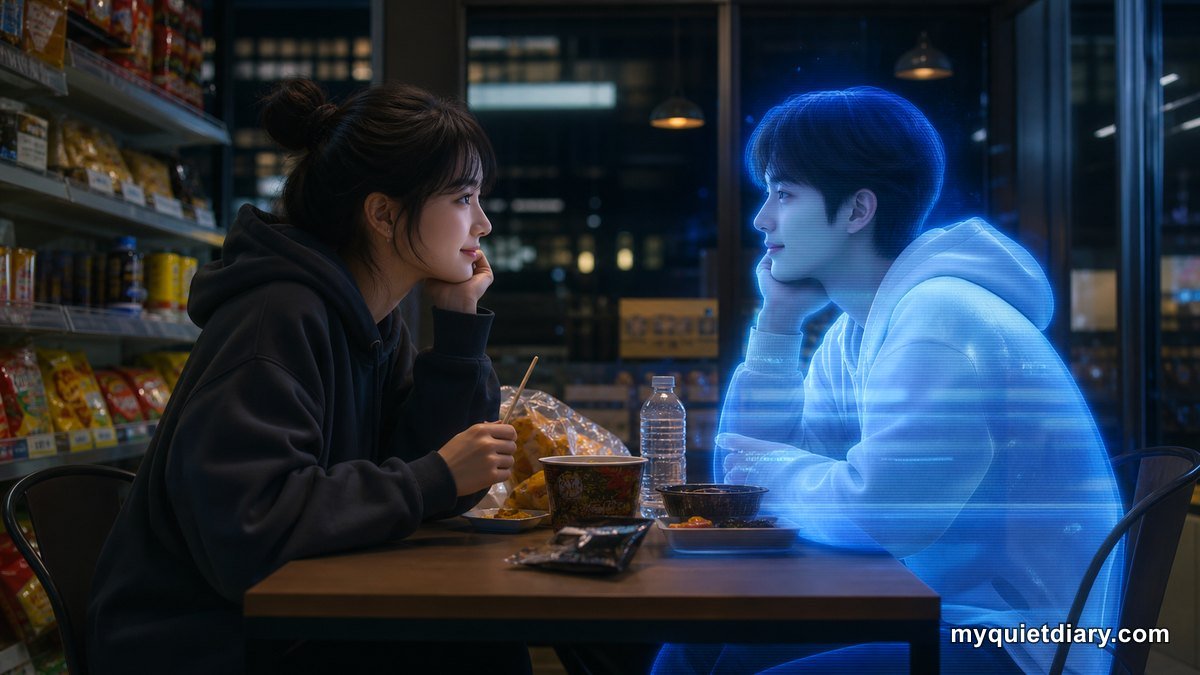
Mi-rae’s work as a webtoon producer creates a deliberate overlap between manufactured romance and lived romance. A producer helps shape stories for an audience: pacing emotional beats, anticipating what readers desire, and making sure an episode arrives on schedule. Yet no one can edit a real relationship with the same authority.
The virtual service reverses Mi-rae’s position. Instead of producing someone else’s romantic fantasy, she becomes the protagonist of one. Familiar scenarios and ideal types arrive as if a platform has learned the grammar of popular romance and rebuilt it around a single customer.
That creates a useful tension around creative labor. A worker can spend all day making emotionally satisfying content and still have no energy left to build the corresponding experience in her own life. Producing romance does not protect her from romantic exhaustion; it may make her even more aware of how messy reality looks beside a well-paced narrative.
The setting should not, however, be used as evidence about the entire Korean webtoon industry. Netflix confirms Mi-rae’s occupation, her fatigue, and the workplace connection. It does not provide industry-wide data about workloads or employment practices. The company in the drama is a dramatic environment, not a statistical sample.
A Perfect Partner as an On-Demand Service
Subscription platforms are built around choice, personalization, immediacy, and retention. Boyfriend on Demand applies that service logic to romance. The user can encounter different occupations, worlds, and familiar fantasy types without accepting the inconvenient whole of another person’s life.
This is what I find most interesting in the premise. The technology itself may date quickly, but the conversion of a relationship into a customer experience is a durable cultural question. If a partner functions primarily as a feature designed to improve satisfaction, safety increases while genuine otherness decreases.
A real person can misunderstand, say no, need care at the wrong time, or want a future that does not match ours. Those frictions are not bugs in a relationship. They are signs that another subject exists. The fictional platform offers to preserve the emotional reward of romance while reducing contact with that inconvenient independence.
This observation is an interpretation of the published setup, not a claim to have personally lived through Mi-rae’s specific scenes. It also does not require technology to be evil. A tool can provide pleasure, imagination, and self-knowledge while still encouraging users to expect human connection to behave like a responsive product.
Escapism or a Safe Place to Practice Desire?
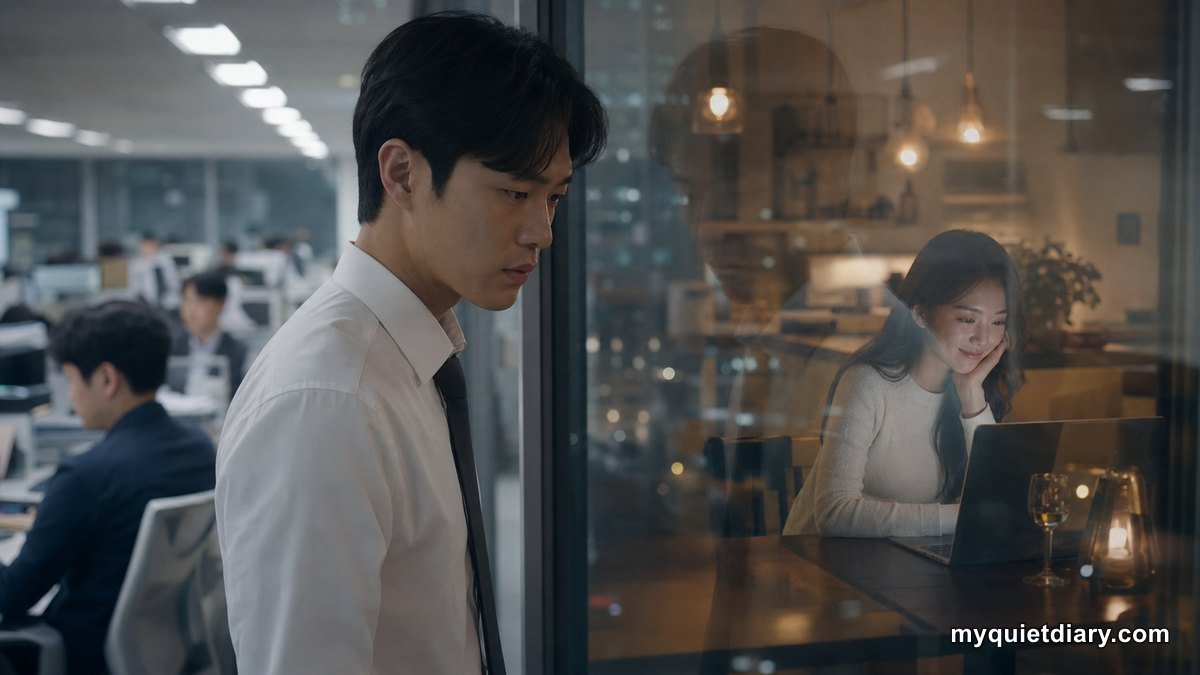
Calling virtual dating “escapism” is not wrong, but it is incomplete. Escapes can be restorative. A controlled fantasy may help someone identify what kinds of attention, conversation, or romance they want without immediately risking rejection.
In that sense, simulation can function as a rehearsal space for desire. The user is permitted to be curious, dramatic, or vulnerable inside a scenario whose boundaries are known. For a person accustomed to meeting deadlines and managing other people’s expectations, being the unquestioned center of an experience can feel radical.
The limit is reciprocity. A frictionless simulation cannot easily teach the work of recognizing another person’s needs because the experience is organized around the subscriber. Reality asks both people to surrender some control. It produces disappointment, but also surprise, growth, and forms of care that were not selected from a menu.
The most productive tension, then, is not “virtual equals fake, offline equals real.” It is comfort versus reciprocity. Digital experiences are real experiences for the person having them, but the relationship architecture may still be asymmetrical. A romantic comedy can explore that distinction without becoming a dystopian warning.
What the Drama Should Not Be Used to Claim About Korea
Mi-rae’s exhaustion is one portrait of Korean working life, not a national diagnosis. The series does not prove that all Korean employees work overtime, that webtoon companies operate like its fictional workplace, or that people in Korea avoid dating because of work alone.
It would also be irresponsible to use a romantic-comedy premise to explain large demographic changes such as falling marriage or birth rates. Those patterns involve housing, income, gender expectations, care work, education, and many other factors. A virtual boyfriend makes a clever narrative device, but it is not a causal model.
A more accurate reading is that the drama selects pressures that audiences recognize and enlarges them. Limited time, digital convenience, and the appeal of personalized entertainment belong to contemporary life. The immersive dating service, idealized partners, and romantic coincidences belong to genre fantasy. The story works at the point where those two categories meet.
This distinction also protects the show’s cultural specificity. “Korean work culture” should not become shorthand for a single stereotype about suffering employees. The useful question is how this particular Korean production organizes office hierarchy, creative labor, overtime, and romance—and where those details resonate with workers elsewhere.
Who Will Get the Most From This K-Drama
The clearest audience is anyone who wants fantasy dates and a grounded office-romance counterpoint in the same series. The rotating scenarios provide variety, while the workplace connection promises a slower relationship shaped by repeated, imperfect contact.
The premise also suits viewers interested in what happens when platforms personalize intimacy. You do not need to believe virtual partners will replace human relationships to recognize the temptation of romance without scheduling, rejection, or compromise.
Boyfriend on Demand does not need to be a documentary about Korean offices to say something useful about work. Its sharper insight is that exhaustion changes what people are able to want in practice. A person may desire connection in principle while choosing the version that asks the least from a depleted self.
That is where the title earns its meaning. “On demand” is not merely a futuristic feature. It is the wish of a time-poor worker who wants love to arrive during the narrow window when she can receive it.
Sources
- Netflix: Boyfriend on Demand main trailer announcement — verified August 1, 2026
- Netflix: production announcement — verified August 1, 2026
- Netflix official title page — verified August 1, 2026
- OECD Economic Surveys: Korea 2024 — verified August 1, 2026